Youth athlete sports psychology
Train your mind. Own your performance. Start where it actually matters.
Trusted by 195+ Clients across U.S.
5.0 Rating on Google

*insurance not accepted
Start Your Mental Performance Training
No pressure. Just a focused conversation about your goals, challenges, and how mental training can help you.
✓ Start Within 48 Hours ✓ Results in 1-2 Sessions
Certified By Leading Professional Organizations
Youth athlete sports psychology is where our group practice starts the conversation, because the mental game does not wait until an athlete turns professional. Young competitors face real pressure. Club championships. Scholarship tryouts. Coaches watching every rep. Parents in the stands. The stakes feel enormous, and when the mind is not trained to match the body, performance suffers. At RE Sports Psychology, we work with youth athletes who are ready to stop hoping it gets better and start training the one thing no conditioning program touches: the mind.
Youth athlete sports psychology is not a single program we hand every young athlete who walks through the door. Every athlete who works with our group practice gets a plan built around them: their sport, their specific challenges, and the emotional patterns that are actually holding their performance back. Some athletes overthink every move mid-competition. Others lose their confidence completely after one bad game. Some freeze when the pressure is highest, even though they are physically ready. These are not signs of weakness. They are solvable problems, and our team is built to solve them fast.
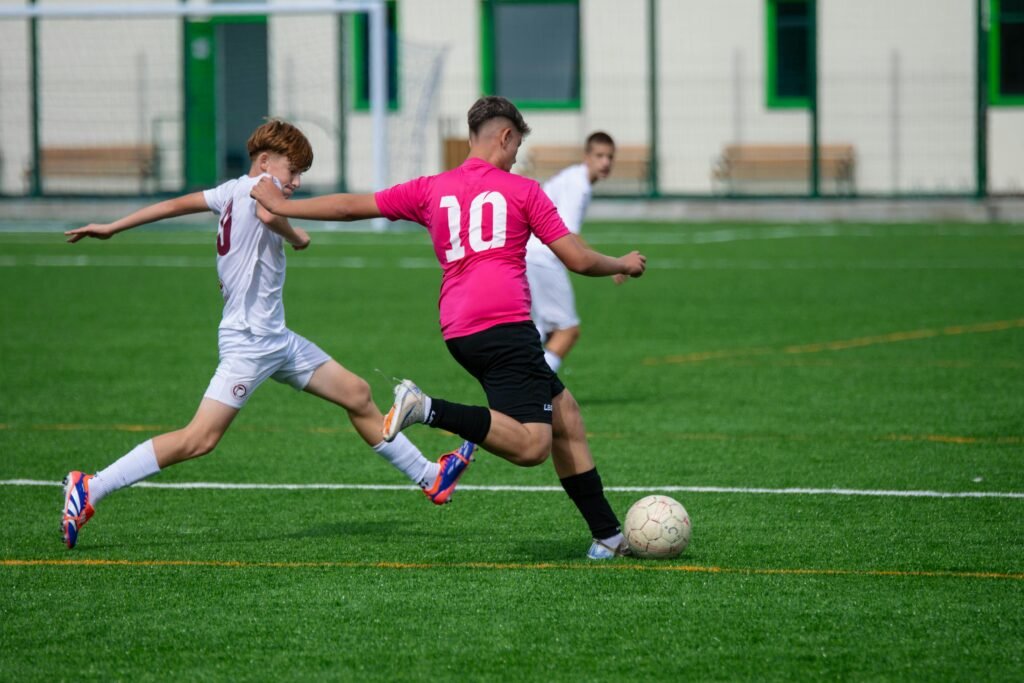
Is your young athlete's mind working against them?
The physical training is there. The technique is sharp. But the moment competition starts, something shifts. Sound familiar?
They choke when it counts, even though they have prepared for this moment
One mistake sends them into a spiral that lasts the rest of the game
They play it safe because failure feels unbearable
A bad performance carries into the next game, then the next, until the slump feels permanent
They stop taking the risks that made them great in the first place
None of this is inevitable. It is a pattern. And patterns can be changed.
What is actually getting in the way
Most performance problems in youth athletes are not about effort or talent. They are driven by emotional patterns that develop over time and quietly chip away at consistency and confidence. Here is what we see most often:
- Performance anxiety. What starts as pre-game nerves becomes a mental habit that fires every time the stakes get high.
- Fear of failure. Athletes terrified of failing stop competing to win and start competing to avoid losing. There is a massive difference in how those two mindsets perform under pressure.
- Fear of success. Some athletes unconsciously pull back right when success is within reach. When success feels unfamiliar or threatening, inconsistency becomes the result no matter how talented the athlete is.
- Fear of embarrassment. The weight of being watched, judged, or humiliated in a competitive setting can shut down an athlete's game before it even starts.
These are not character flaws. They are mental habits. And our job is to find them, correct them, and replace them with habits that actually serve the athlete’s performance.
How we train the mental game
At RE Sports Psychology, our group practice combines sports psychology, performance coaching, and cognitive hypnotherapy to get to the root of what is limiting a youth athlete’s performance. We do not spend session after session talking about feelings. We identify the specific emotional patterns driving the problem and correct them, so improvements show up in competition, not just in a session.
Every athlete we work with receives a fully customized approach. The tools we use are selected based on what each individual needs
Guided imagery
Trains the athlete's mind to rehearse elite performance with precision. When the brain has vivid, repeated exposure to executing under pressure, competition starts to feel familiar rather than threatening.
Progressive muscle relaxation
Gives athletes the ability to recognize and release physical tension in real time. For athletes who carry anxiety in their body before or during competition, this skill changes everything.
Cognitive hypnotherapy
Works at the subconscious level to uncover the emotional drivers behind performance blocks, fear responses, and confidence crashes. Accelerated, focused, and built for athletes who want results fast.
The goal is not to create athletes who depend on ongoing sessions to perform. The goal is to build athletes who own their mental game completely, and can access it on command.
Why starting early is the edge most athletes miss
The emotional patterns a young athlete develops now do not disappear on their own. An athlete who learns to manage pressure, recover quickly from setbacks, and compete with clarity and confidence at 16 carries those skills into every level of competition that follows. An athlete who does not will carry the other patterns too.
- Perform under pressure consistently
- Reset fast after mistakes
- Compete without fear of failure
- Build confidence that holds under pressure
- Develop mental habits that last beyond any single season
- Train skills that transfer beyond sport
Getting ahead of the mental game early is one of the most powerful investments a young competitor can make, not just for sport, but for everything that follows.
What to expect when you reach out
Getting started is straightforward. No unnecessary paperwork. No vague intake forms. No pressure to commit before you are ready.
Free 15-minute consultation We hear what is going on, understand the athlete's specific challenges, and answer your questions.
Comprehensive intake session Our team builds a complete picture of the athlete's goals and the patterns driving the performance issue. Everything that follows is built on this foundation.
Focused, customized sessions Each session has a clear purpose. Progress is reviewed regularly and adjusted based on real results, not a fixed schedule.
Independent performance As new mental skills become stable, sessions taper naturally. Athletes leave equipped to perform on their own, which is the goal from day one.
What we help youth athletes overcome
- Performance anxiety before and during competition
- Fear of failure and fear of success
- Confidence loss following injury or a difficult stretch
- Emotional inconsistency under competitive pressure
- Overthinking and mental blocks during play
- Fear of embarrassment or humiliation in competitive settings
- Pain management and mental recovery from injury
Each situation is addressed with a plan built specifically for that athlete. No two athletes get the same approach, because no two athletes arrive with the same challenges.
In-person and online sessions available
Our group practice offers both in-person and online sessions. Online sessions deliver the same depth and quality of work and fit easily around demanding training and competition schedules. Wherever your athlete is, we can meet them there.
Reach out to our team to ask about availability, scheduling, and next steps. If you are ready to start, we are ready to build the plan.
Frequently asked questions
A youth athlete is any young competitor, typically between the ages of 8 and 18, who participates in organized sport at any level, from recreational leagues to elite junior programs. Youth athletes face many of the same mental performance demands as adult competitors: pressure to perform, fear of failure, confidence fluctuations, and the challenge of staying consistent when the stakes are high. What makes this stage critical is that the mental habits formed during youth sports often follow an athlete well into adulthood. At RE Sports Psychology, our group practice works specifically with youth athletes to build the mental skills that give them a lasting edge at every level of competition ahead.
The 5 C's in sports psychology refer to five core mental performance qualities that research consistently links to athletic success: Commitment, Confidence, Concentration, Control, and Cohesion. For youth athletes, developing these qualities early creates the mental foundation that separates consistent performers from those who plateau despite strong physical preparation. At RE Sports Psychology, our work with young athletes directly targets the most common breakdowns in these areas, particularly confidence after a difficult performance, emotional control under pressure, and the ability to concentrate without overthinking. Every plan is built around the specific C's that each individual athlete needs to strengthen.
Sports psychologists help athletes identify and correct the mental and emotional patterns that interfere with performance. For youth athletes, this often means addressing performance anxiety, fear of failure, confidence loss after injury, or overthinking that shuts down a game-ready athlete the moment pressure peaks. At RE Sports Psychology, our group practice goes a step further by combining sports psychology with performance coaching and cognitive hypnotherapy. This allows our team to work at both the conscious and subconscious level, correcting the root emotional drivers of performance problems, not just managing the surface-level symptoms. The result is faster, more durable progress that shows up in competition.
The 4 C's of sports psychology are Confidence, Concentration, Control, and Commitment. These are the mental pillars most commonly targeted in performance work with athletes. For youth athletes, these four qualities can make the difference between performing at their ceiling or falling short of it under competitive pressure. Our group practice at RE Sports Psychology addresses each of these areas through a fully customized approach. Confidence work helps young athletes rebuild and sustain self-belief after setbacks. Concentration training reduces overthinking and sharpens focus during competition. Control work gives athletes real tools to manage emotional responses in the moment. Commitment work strengthens the mental habits that keep athletes performing with purpose even when conditions are difficult.
Youth athletes are generally defined as competitors between the ages of 8 and 18, though this range can vary depending on the sport and level of competition. What matters more than the specific age range is when the mental demands of sport start to outpace what the athlete's current mental skills can handle, and for many young competitors that happens well before high school. At RE Sports Psychology, our group practice works with youth athletes across this full age range, tailoring our approach to where the athlete is developmentally, emotionally, and competitively. There is no single starting point. The right moment for each individual athlete to begin building a mental game that matches their physical preparation.
The five pillars most widely recognized in sport psychology are: motivation, confidence, focus, emotional control, and mental resilience. These pillars form the foundation of consistent athletic performance, and when any one of them is unstable, the effects show up quickly in competition. Our work with youth athletes at RE Sports Psychology is designed to identify which pillar, or combination of pillars, is at the root of a performance problem, and correct it directly. Rather than spending sessions working on all five equally, our team pinpoints what is actually limiting each athlete and builds a plan that targets the specific gaps driving their inconsistency.
Youth sports psychology is important because the mental habits formed during early athletic development do not stay in the gym or on the field. They carry forward. A young athlete who learns to manage pressure, recover from setbacks quickly, and compete with composure develops skills that transfer to every level of sport ahead, and to life beyond competition. More urgently, performance anxiety, fear of failure, and confidence instability are far easier to correct early than after years of reinforcement. The athletes who address these patterns during youth sport arrive at higher levels of competition with a mental edge their peers simply have not built. At RE Sports Psychology, that is exactly the outcome our group practice works toward.
Sessions with a youth athlete at RE Sports Psychology are structured, focused, and built around a clear purpose, not open-ended conversations. After an initial comprehensive consultation that maps the athlete's specific challenges and emotional patterns, each session targets a defined aspect of the athlete's mental performance. Depending on the athlete, sessions may include guided imagery to sharpen mental rehearsal skills, progressive muscle relaxation to build real-time tension control, or cognitive hypnotherapy to address the subconscious patterns driving fear, anxiety, or inconsistency. Every session has a direction, every session is adjusted based on progress, and every tool used is selected specifically for that athlete.
If your young athlete is physically prepared but consistently underperforms when it matters most, that is a strong signal. Other signs to watch for include:
- Persistent nerves or anxiety before games or competitions
- A loss of confidence that does not recover after a bad performance
- Emotional shutdown, frustration, or withdrawal during high-pressure moments
- Fear of making mistakes that causes them to play it safe rather than compete freely
- A visible drop in performance following injury or a difficult stretch
If any of these patterns feel familiar, a free 15-minute consultation with our group practice is the clearest next step. There is no commitment required. Just a focused conversation about what your athlete is experiencing and whether our approach is the right fit.
At RE Sports Psychology, our group practice is specifically designed to produce results efficiently. We are not built for indefinite ongoing sessions. Our approach combines sports psychology, performance coaching, and cognitive hypnotherapy to get to the root of what is limiting performance and correct it in the fewest sessions possible, without sacrificing quality. Many youth athletes begin to notice meaningful changes in their focus, composure, and confidence within the first few sessions. The exact timeline depends on the nature of the challenge, how long the patterns have been in place, and how consistently the athlete engages with the process. Our goal is always measurable progress in competition, not a long-term dependency on our practice.
Your Performance Is Waiting
You’ve already done the physical work. Now it’s time to train your mind. Take the first step toward clearer focus, stronger confidence, and consistent performance when it matters most.
RE Sports Psychology is a group practice that helps athletes resolve the mental performance issues that get in the way of consistent, confident competition. Using a targeted blend of sports psychology, performance coaching, and cognitive hypnotherapy, our team works to identify the emotional and subconscious root causes behind performance anxiety, overthinking, confidence struggles, and pressure-related setbacks. Every client receives a customized approach built around their specific situation and goals, with sessions designed to produce measurable improvements efficiently. We offer both in-person and online sessions and are focused on helping athletes develop the clarity, composure, and self-reliance they need to perform at their highest level when it counts.