Tennis sports psychology
Because the gap between your practice game and your match game is mental, not physical.
Trusted by 195+ Clients across U.S.
5.0 Rating on Google

*insurance not accepted
Start Your Mental Performance Training
No pressure. Just a focused conversation about your goals, challenges, and how mental training can help you.
✓ Start Within 48 Hours ✓ Results in 1-2 Sessions
Certified By Leading Professional Organizations
Tennis sports psychology is built for the moments that define your season. The tight third set. The tiebreak where everything is on the line. The serve at match point when your legs feel like concrete and your thoughts are moving faster than your racket. You have done the physical work. You have put in the court time. But something in your mental game is costing you, and you already know it. At RE Sports Psychology, our group practice works specifically with tennis players who are ready to fix that, through in-person and online sessions designed to produce results that show up in competition.
Tennis sports psychology is not about talking through your feelings for months without a clear endpoint. Our approach is direct, structured, and built around one goal: getting you to perform at your best when the pressure is highest. Every session is fully customized to you, your sport, your mental patterns, and the specific performance challenges that are holding you back right now.
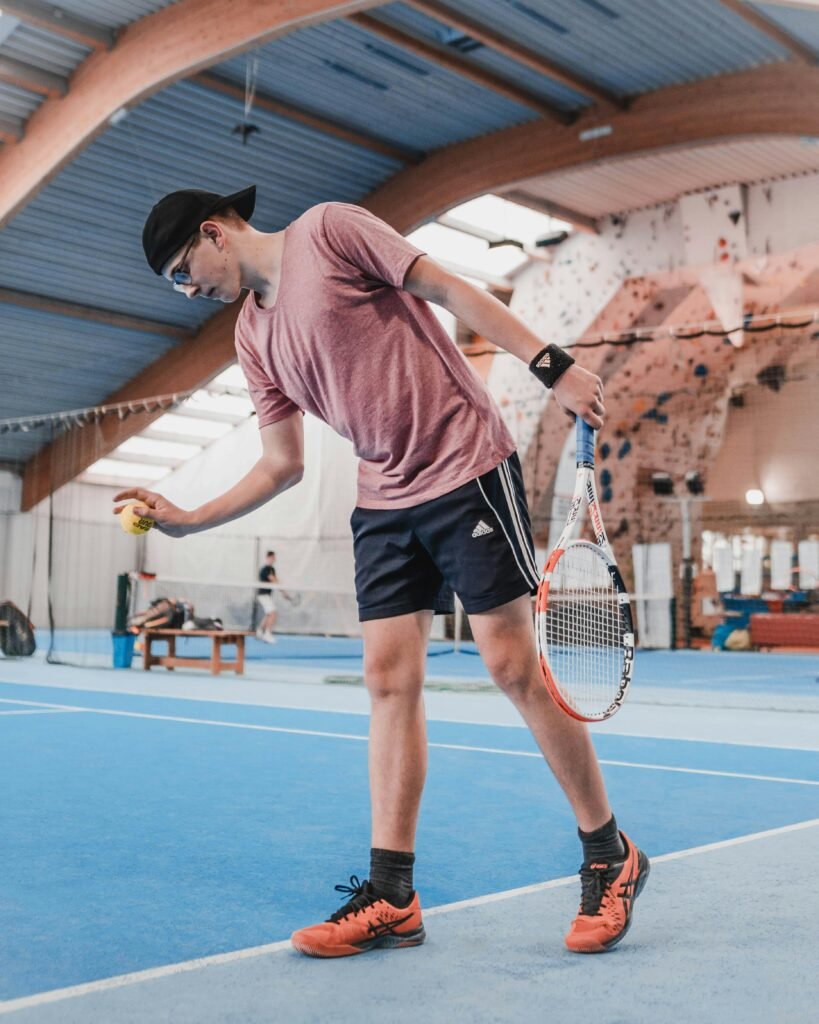
Tennis exposes everything
There is no sport quite like tennis when it comes to mental exposure. You are alone out there. No coach. No teammates. No one to share the momentum shift when a match starts slipping away.
Between every point, you have a few seconds to reset, refocus, and step back into the next exchange with composure and clarity. Over the course of a long match, that mental discipline either holds or it fractures. Most tennis players already know exactly where their game breaks down:
- Not on the practice court
- Not during casual matches
- Always in the moments that matter most
A serve that flies in practice suddenly refuses to land. A forehand that feels automatic breaks down when the score is close. That gap between what you can do and what you actually do under pressure is not a technique problem. It is a mental performance problem. And that is exactly what we correct.
Is your mind sabotaging your game?
The athletes who come to our group practice are not struggling because they lack talent or preparation. They struggle because their mental game has not caught up to their physical one. Here is what that looks like on the court:
- Performance anxiety that disrupts your mechanics at the worst possible moments
- Fear of failure pushing you toward safe, low-percentage shots when you need to be aggressive
- Fear of success creating unconscious hesitation right when a significant result is within reach
- Lost confidence after an injury, a bad run of results, or a match that is still living in your head
- Emotional inconsistency, unraveling after errors, double faults, or momentum shifts
- Injury-related mental blocks that stop you from trusting your body the way you did before
- The weight of past embarrassment quietly shaping how you compete today
Any of those sound familiar? These are not weaknesses. They are patterns. And patterns can be corrected.
What we do differently
At RE Sports Psychology, our group practice combines sports psychology, performance coaching, and cognitive hypnotherapy into a single, integrated approach. Most mental performance work operates only at the surface level. That is why it does not stick. Our team works at the deeper layer, where performance anxiety, fear-based decision-making, and emotional reactivity actually live. Here is what that looks like in practice:
- Cognitive hypnotherapy: Corrects the subconscious patterns driving your performance issues. Fast, precise, and built for athletes who want results, not an indefinite process.
- Guided imagery: Mentally rehearse high-pressure match situations before you are back on the court. Close the gap between your practice performance and your match performance.
- Progressive muscle relaxation: Identify and release the physical tension that pressure creates in your body. Tight shoulders and a gripping hand affect every shot. This gives you control over that.
- Sports psychology: The mental performance foundation of everything we do. Structured, evidence-informed, and applied directly to the demands of competitive tennis.
This is not traditional talk therapy stretched across months. It is targeted mental performance work designed to produce change fast, and to produce results you can feel on the court.
Customized for you, not built for everyone
There is no standard program here. No curriculum that every tennis player moves through in the same order. Our process begins by mapping exactly what needs to change and why. Before any focused work begins, we take the time to understand:
- Your specific performance challenges on the court
- The emotional and subconscious patterns driving them
- Your goals, your history, and what success actually looks like for you
That information shapes every session that follows. Nothing is guesswork. Nothing is borrowed from another athlete’s plan. Everything is built around you.
What to expect when you start
Our intake process is simple, direct, and intentional. Here is how it works:
- A complimentary 15-minute consultation to talk through your challenges, assess fit, and answer your questions, no pressure, no commitment
- A comprehensive consultation where we narrow down your goals, map your emotional patterns, and design a fully customized approach aimed at results in the fewest sessions possible
- Focused sessions with a clear direction, a measurable purpose, and regular progress reviews built in
- A natural taper as results stabilize, leaving you with the tools to manage your own mental performance independently
No unnecessary paperwork. No vague plans. No pressure to commit to long-term treatment before you have seen what this work can do.
Results you can take on the court
Our goal is not to have you relying on our group practice indefinitely. We measure success by what you are able to do on the court after this work is done. The mental tools and emotional regulation skills you develop through our process are yours to keep. They go with you into every match, every tiebreak, every moment where the score is close and the pressure is real.
You become the kind of player who trusts themselves under pressure, not because you are ignoring the pressure, but because you have trained your mind to perform through it.
Online and in-person sessions
Our group practice offers both online and in-person sessions built around the demanding schedules that competitive tennis requires. Whether you are traveling for tournaments, training across multiple locations, or simply prefer to work remotely, our online format delivers the same quality of care. Sessions are equally focused and equally effective regardless of how you access them.
Who we work with
We work with tennis players at every competitive level:
Junior athletes building their mental game before it becomes a liability
Collegiate players navigating high-pressure competitive environments
Adult competitors who take their performance seriously and want results to match
Professionals looking for a measurable mental edge at the highest level of the game
The common thread is not ranking or age. It is a readiness to stop managing symptoms and start correcting the root cause of what is limiting your game. If that sounds like you, our group practice is likely the right fit.
Your next step
You have already done the physical work. You know what you are capable of. The gap between that and what you are currently producing in competition is mental — and it can be closed faster than you think.
Reach out to schedule your free 15-minute consultation. Our team will walk you through the process, answer your questions, and help you decide if our approach is the right fit. For scheduling, session format options, and next steps, contact us directly. Your best performances are not behind you.
Frequently asked questions
Yes, and most tennis players discover this the hard way. The physical demands of tennis are only part of the equation. Between every point, you are making rapid decisions, managing your emotions, and fighting to maintain focus without any teammates or in-game coaching to lean on. Research consistently shows that mental performance accounts for a significant portion of competitive outcomes in tennis. Players who develop their mental game alongside their physical one do not just compete better. They compete more consistently, especially when the match is on the line.
The 4 C's are Concentration, Confidence, Control, and Commitment. In tennis, Concentration keeps you present on the current point instead of replaying the last error. Confidence allows you to execute aggressively when the score is tight. Control gives you the emotional regulation to reset after momentum shifts. Commitment drives consistent effort across long matches and full seasons. At RE Sports Psychology, our group practice builds all four through a fully customized approach tailored to each athlete's specific performance patterns.
Tennis develops focus, emotional resilience, and the ability to manage pressure in real time. The sport demands rapid mental recovery after mistakes, sustained concentration over long matches, and the capacity to perform alone under stress. These are mental skills that translate well beyond the court. That said, when the mental demands of tennis are creating anxiety, fear of failure, or emotional dysregulation, those issues deserve targeted attention rather than the assumption that more playing time will fix them on its own.
Unlike team sports, tennis puts the full mental load on one person. There is no coach to redirect strategy mid-match. There is no teammate to absorb a momentum shift. Every decision, every emotional reaction, and every recovery from an error happens in isolation and in full view of everyone watching. Add in the stop-start rhythm of points, the brief windows between exchanges, and the physical fatigue that compounds over a long match, and you have a sport that is as much a mental endurance event as a physical one.
Performance anxiety in tennis is the experience of fear, overthinking, or physical tension that disrupts your ability to execute when the stakes are high. It often shows up as a reliable serve that breaks down at match point, a forehand that feels different under pressure, or racing thoughts that pull your attention away from the current point. At RE Sports Psychology, our group practice treats performance anxiety at its root through cognitive hypnotherapy, guided imagery, and progressive muscle relaxation. The goal is not to manage anxiety indefinitely. It is to correct the emotional and subconscious patterns driving it so it no longer controls your game.
Yes. Choking under pressure is one of the most common issues our group practice addresses with tennis players. It is not a talent problem or a preparation problem. It is a mental performance problem, rooted in emotional and subconscious patterns that activate under high-stakes conditions. Our approach uses cognitive hypnotherapy to access and correct those deeper patterns, not just address the surface-level symptoms. Most athletes who come to us for this specific challenge notice a meaningful shift within the first few sessions.
Effective mental strategies in tennis include pre-point routines that reset focus between exchanges, controlled breathing to manage physical tension and emotional regulation, positive self-talk to counteract error-based thinking, and mental rehearsal to build confidence before high-pressure situations. At RE Sports Psychology, our group practice develops these strategies through a personalized process that is built around each athlete's specific challenges rather than a one-size-fits-all program. The strategies you leave with are designed to work in your game, not just in theory.
Fear of failure in tennis typically shows up as overly conservative shot selection, hesitation at critical moments, or a tendency to play not to lose rather than playing to win. It often develops after high-pressure losses, public errors, or a pattern of performing below expectation at key moments. Left unaddressed, it compounds over time and begins to shape the way an athlete approaches competition at a subconscious level. Our group practice works to identify the specific emotional drivers behind fear of failure and correct them directly, so players can compete with the same freedom in a match that they experience in practice.
Yes. Injury recovery is one of the most overlooked mental performance challenges in tennis. After significant time away from the court, many players return physically cleared but mentally hesitant. They stop trusting their body. They play cautiously in situations that require aggression. They carry the psychological weight of the injury into every point. Our group practice addresses this through a targeted process that rebuilds trust, restores confidence in physical execution, and corrects the mental patterns that form during recovery before they become long-term performance habits.
Tennis is one of the few sports that forces athletes to develop mental toughness by design. The solo nature of competition, the rapid emotional cycles across a long match, and the constant requirement to reset after mistakes all build psychological resilience over time. But developing mental toughness through experience alone is a slow and often inconsistent process. Working with our group practice accelerates that development by targeting the specific mental and emotional patterns that are limiting your game now, rather than waiting for experience to correct them on its own timeline.
Your Performance Is Waiting
You’ve already done the physical work. Now it’s time to train your mind. Take the first step toward clearer focus, stronger confidence, and consistent performance when it matters most.
RE Sports Psychology is a group practice dedicated to helping athletes and high-performing individuals close the gap between their physical preparation and their on-field execution. We combine sports psychology, performance coaching, and cognitive hypnotherapy to address the emotional and subconscious drivers of performance anxiety, inconsistency, loss of confidence, and pressure-related breakdowns. Rather than open-ended treatment, our approach is structured around a thorough initial consultation that allows us to design customized sessions aimed at producing results fast, in fewer sessions than traditional approaches, without sacrificing quality. We offer both in-person and online sessions, making it easy to fit high-quality mental performance training into your schedule.